BlogRazvoj
Three principles that guided Crolingo's development
Mayntech5 November 20253 min read
After watching Wafa at the Zvončac shop buy sugar instead of salt because she couldn't communicate with the cashier, we knew the language barrier wasn't an academic problem. It's concrete, everyday, and solvable.
But good intentions aren't enough. We needed principles — things we don't negotiate on, even when developers and investors ask perfectly logical questions.
Principle 1: The user's native language, not English as a proxy
Crolingo has an interface in 24 languages. A developer once asked us: "Why not just English and Croatian? Everyone speaks English anyway."
No, they don't. That's a privileged assumption.
Wafa speaks Arabic. Someone else speaks Bengali, Nepali, Tagalog. Expecting people to learn Croatian through English means they first have to know enough English to understand the instructions. That's not helping — that's adding another barrier.
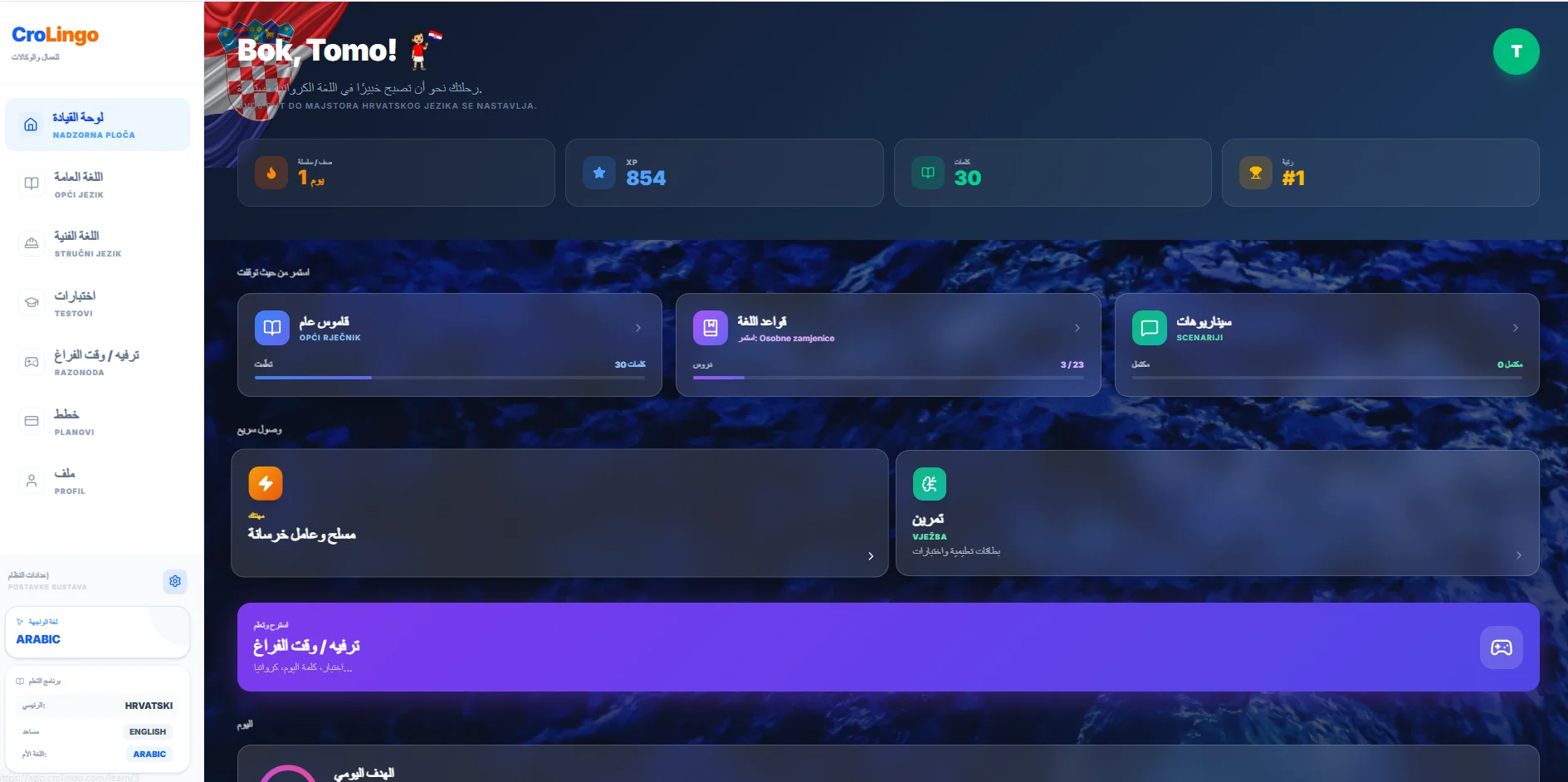
So in Crolingo, you pick your language and learn Croatian directly from it. Explanations, translations, grammar concepts — all in the language you actually understand. We don't ask you to know English in order to learn Croatian.
Principle 2: Functional Croatian, not academic
When you learn a language, academic institutions start with grammar. Future tense, genitive plural, conditionals.
We start with a scenario: a shop, a hospital, a nursery, a job site. "Salt, not sugar." "My throat hurts." "I need the bill."
Grammar comes when it's needed for understanding. Not before. That's why Crolingo has 74 sector scenarios — context where language actually makes sense, not abstract exercises. Construction, hospitality, hotels, healthcare, transport, shipbuilding.
Academic Croatian has its value. Functional Croatian keeps you going.
Principle 3: B2B and B2C together, not separate
Someone asked us: "Why not build a B2B version separately? Why the same platform?"
Because it's the same problem, different context.
A person needs to learn Croatian — for the shop, work, school. An employer, a city, or a school needs structure: insights, who's progressing, who needs support, how to organise learning.
Crolingo solves both: users learn through the app, organisations get a dashboard, admin panel, and group management through Crolingo Business. Splitting them would duplicate the problem — two products, two code bases, twice the maintenance.
Instead, we're building one platform that scales from a single learner to an agency with 200+ workers. The same quality of learning, different levels of control and insight.
Why principles matter
Each of these principles comes with a cost. 24 interface languages means 24 sets of translations to maintain. A functional approach means content that has to be written by hand, not generated. B2B + B2C on one platform means a more complex architecture.
But a principle isn't a principle if you drop it the moment it gets inconvenient.
Wafa bought sugar instead of salt because she couldn't communicate. Not because she wasn't smart enough, but because she didn't have a tool that understood her. Crolingo is that tool.
Next post: how Crolingo was actually built. The stack, the technology, what worked from day one, and what we had to rewrite three times.
Need help with a project?
Talk to us — directly, no sales pitch.